Showing posts with label Folks. Show all posts

Sunday, August 29, 2010

The Letters of Vincent van Gogh


I am reading the Letters of Vincent van Gogh and it is tremendous. Here are just a few quotes I've gleaned from it, and I'm only on page 116:
  • Now, one of the reasons why I have no regular job, and why I have not had a regular job for years, is quite simply that my ideas differ from those of the gentlemen who hand out the jobs to individuals who think as they do.
  • I am a man of passions, capable of and given to do more or less outrageous things for which I sometimes feel a little sorry. Every so often I say or do something too hastily when it would have been better to have shown a little more patience.
  • Father once wrote to me, 'Do not forget the story of Icarus, who wanted to fly to the sun, and having reached a certain height lost his wings and fell into the sea.' You may often feel that neither [Anna] nor I are what we hope to become and that we still lag a long way behind Father and other people, that we lack sandiness and sincerity. One does not become simple and true overnight. But let us persevere, and above all have patience. He who believes, does not hasten. Still there is a difference between our desire to become Christians and that of Icarus to fly to the sun.
  • But I cannot help but thinking that the best of way of knowing God is to love many things. Love this friend, this person, whatever you like, and you will be on the right road to understanding him better, that is what I keep telling myself. But you must love with sublime, genuine, profound sympathy, with devotion, with intelligence, and you must try all the time to understand him more, better and yet more. That will lead to God, that will lead to an unshakable faith.

Sunday, April 4, 2010

Psst!


For some reason -

and it has nothing to do with Easter

or this bright, spring day -

today I thought of Schneider

from One day at a Time.

I used to love that show.

Tuesday, March 23, 2010

Folks: Photographer Series


Baron George Hoyningen-Huene (1900 - 1968) was a seminal fashion photographer of the 1920s and 1930s. He was born in Russia to Baltic German and American parents and spent his working life in France, England and the United States.[citation needed]

Born in Saint Petersburg, Russia, on September 4, 1900, Hoyningen-Huene was the only son of Baron Barthold Theodor Hermann (Theodorevitch) von Hoyningen-Huene (1859-1942), a Baltic nobleman, military officer and lord of Navesti manor (near Võhma), and his wife, Emily Anne "Nan" Lothrop (1860-1927), a daughter of George Van Ness Lothrop, an American minister to Russia. (The couple was married in Detroit, Michigan, in 1888.) He had two sisters. Helen (died 1976) became a fashion designer in France and the United States, using the name Helen de Huene. Elizabeth (1891-1973), also known as Betty, also became a fashion designer (using the name Mme. Yteb in the 1920s and 1930s) and married, first, Baron Wrangel, and, second, Lt. Col. Charles Norman Buzzard, a British Army officer.

During the Russian Revolution, the Hoyningen-Huenes fled to first London, and later Paris. By 1925 George had already worked his way up to chief of photography of the French Vogue. In 1931 he met Horst, the future photographer, who became his lover and frequent model[citation needed] and traveled to England with him that winter. While there, they visited photographer Cecil Beaton, who was working for the British edition of Vogue. In 1931, Horst began his association with Vogue, publishing his first photograph in the French edition of Vogue in November of that year.

In 1935 Hoyningen-Huene moved to New York City where he did most of his work for Harper's Bazaar. He published two art books on Greece and Egypt before relocating to Hollywood, where he earned his wedge by shooting glamorous portraits for the film industry.

Hoyningen-Huene worked before anything resembling contemporary flash photography was known.[neutrality is disputed] Working in huge studios and with whatever lighting worked best. There is something about the texture of his black and whites that one seldom finds in contemporary work. Beyond fashion, he was a master portraitist as well from Hollywood stars to other celebrities.[original research?]

He also worked in Hollywood in various capacities in the film industry, working closely with George Cukor, notably as special visual and color consultant for the 1954 Judy Garland movie A Star Is Born. He served a similar role for the 1957 film Les Girls, which starred Kay Kendall and Mitzi Gaynor, the Sophia Loren film Heller in Pink Tights and The Chapman Report.

In 1952 his cousin Baron Ernst Lyssardt von Hoyningen-Huene, whom he had adopted, married Nancy Oakes, the daughter of the gold mining tycoon Sir Harry Oakes. That union lasted until 1956 and produced one son Baron Alexander von Hoyningen-Huene. Baron Alexander von Hoyningen-Huene is also known as Sasha.

He died at 68 years of age in Los Angeles.

via Wikipedia, image via Glamour Splash

Folks: Photographer Series


Edward Henry Weston (March 24, 1886 – January 1, 1958) was an American photographer, and co-founder of Group f/64. Most of his work was done using an 8 by 10 inch view camera.

Weston was born in Highland Park, Illinois on March 24, 1886. [1] He was given his first camera, a Kodak Bull's-Eye #2, for his 16th birthday, when he began taking photographs. His favorite hangouts were Chicago parks and a farm owned by his aunt. Weston met with quick success and the Chicago Art Institute exhibited his photographs a year later, in 1903. He attended the Illinois College of Photography.

In 1906, Weston moved to California, where he decided to stay and pursue a career in photography. He had four sons with his wife, Flora May Chandler (whom he married in 1909): Edward Chandler (Chan) (1910), Theodore Brett (1911), Laurence Neil (Neil)(1914) and Cole (1919). In 1910, Weston opened his first photographic studio in Tropico, California (now Glendale) and wrote articles about his unconventional methods of portraiture for several high-circulation magazines.

In 1922, Weston experienced a transition from pictorialism to straight photography, becoming "the pioneer of precise and sharp presentation". His pictures included the human figure as well as items of nature, including seaside wildlife, plants, and landscapes. Tina Modotti, his professional (and romantic) partner, often accompanied him to Mexico, creating much gossip in the media. Weston's sons were also frequent companions, receiving lessons in photography from their experienced father. Brett and Cole later embarked on their own careers in the field, along with Weston's grandson Kim and great-children, Christine and Jason.

After 1927, Weston worked mainly with nudes, still life — his shells and vegetable studies were especially important — and landscape subjects. Henrietta Shore was a companion in the 1930s; her paintings influenced him to photograph her shells.[2] After a few exhibitions of his works in New York, he co-founded Group f/64 in 1932 with Ansel Adams, Willard Van Dyke and others. The term f/64 referred to a very small aperture setting on a large format camera, which secured great depth of field, making a photograph appear evenly sharp from foreground to background. Weston also achieved great sharpness by not enlarging. He made contact prints from his 4x5" or 8x10" negatives. The detailed, straight photography that the group espoused was in opposition to the pictorialist soft-edged methods that were still in fashion at the time.

In 1937 the Solomon R. Guggenheim Foundation awarded Weston a fellowship, the first given to a photographer. In 1939, he married his assistant, Charis Wilson, with whom he had lived since 1934. They divorced in 1945.[3] During this time he received exclusive commissions and published several books, some with Wilson, including an edition of Whitman's Leaves of Grass illustrated with his photographs. He also produced some of his few color photographs with Willard Van Dyke in 1947. Weston also collaborated on several volumes of his photographs with photography critic Nancy Newhall, beginning in 1946.

The Center for Creative Photography at the University of Arizona in Tucson houses a full archive of Edward Weston's work.

Stricken with Parkinson's Disease, Weston made his last photographs at Point Lobos State Reserve in 1948. 1952 saw the publication of a 50th-anniversary portfolio of his work, printed by his son Brett. Brett and Cole Weston, as well as Brett's wife Dody Warren, were appointed to print 800 of what he considered his most important negatives under his supervision in the years 1955 to 1956.

Edward Weston died in his house on Wildcat Hill in Carmel Highlands in Big Sur, California on January 1, 1958, at age 71.

via Wikipedia, image via ArtNet

Folks: Photographer Series


Anne Wardrope (Nott) Brigman (1869 - 1950) was an American photographer and one of the original members of the Photo-Secession movement in America. Her most famous images were taken between 1900 and 1920, and depict nude women in primordial, naturalistic contexts.

Brigman was born in the Nuuanu Valley above Honolulu, Hawaii on 3 December 1869. She was the oldest of eight children born to Mary Ellen Andrews Nott, whose parents has moved to Hawaii as missionaries in 1828. Her father, Samuel Nott, was from Gloucester, England. When she was sixteen her family moved to Los Gatos,California, and nothing is known about why they moved or what they did after arriving in California. In 1894 she married a sea captain, Martin Brigman. She accompanied her husband on several voyages to the South Seas, returning to Hawaii at least once.

Imogen Cunningham recounts a story supposedly told to her firsthand that on one of the voyages Brigman fell and injured herself so badly that one breast was removed.[1] Whether this is true or not, after 1900 she stopped traveling with her husband and became active in the growing bohemian community of the San Francisco Bay area. She was close friends with the writer Jack London and the poet and naturalist Charles Keeler. Perhaps seeking her own artistic outlet, she began photographing in 1901. Soon she was exhibiting in local photographic salons, and within two years she had developed a reputation as a master of pictorial photography. In late 1902 she came across a copy of Camera Work and was captivated by the images and the writings of Alfred Stieglitz. She wrote Stieglitz praising him for the journal, and Stieglitz in turn soon became captivated with Brigman's photography. In 1902 he listed her as an official member of the Photo-Secession, which, because of Stieglitz's notoriously high standards and because of her distance from the other members in New York, is a significant indicator of her artistic status. IN 1906 she was listed as a Fellow of the Photo-Secession, the only photographer west of the Mississippi to be so honored.[2]

From 1903 to 1908 Stieglitz exhibited Brigman's photos many times, and her photos were printed in three issues of Stieglitz's journal Camera Work. During this same period he often exhibited and corresponded under the name "Annie Brigman", but in 1911 she dropped the "i" and was known from then on as "Anne". Although she was well known for her artistic work, she did not do any commercial or portrait work like some of her comptemporaries. In 1910 she and her husband separated, and she moved into a house with her mother. By 1913 she was living alone "in a tiny cabin...with a red dog...and 12 tame birds".[1] She continued to exhibit for many years and was included in the landmark International Exhibition at the Albright-Knox Art Gallery in New York in 1911 and the Internation Exhibition of Pictorial Photography in San Francisco in 1922.

In California, she became revered by West Coast photographers and her photography influenced many of her contemporaries. Here, she was also known as an actress in local plays [1], and as a poet performing both her own work and more popular pieces such as Enoch Arden [2]. An admirer of the work of George Wharton James, she photographed him on at least one occasion [3].

She continued photography through the 1940s, and her work evolved from a pure pictorial style to more of a straight photography approach, although she never really abandoned her original vision. Her later close-up photos of sandy beaches and vegetation are fascinating abstractions in black-and-white. In the mid-1930s she also began taking creative writing classes, and soon she was writing poetry. Encouraged by her writing instructor, she put together a book of her poems and photographs call Songs of a Pagan. She found a publisher for the book in 1941, but because of World War II the book was not printed until 1949, one year before she died. Brigman died on 8 February 1950 at her sister's home in El Monte, California.

Brigman's photographs frequently focused on the female nude, dramatically situated in natural landscapes or trees. Many of her photos were taken in the Sierra Nevada Mountains in carefully selected locations and featuring elaborately staged poses. Brigman often featured herself as the subject of her images. After shooting the photographs, she would extensively touch up the negatives with paints, pencil, or superimposition.

Brigman's deliberately counter-cultural images suggested bohemianism and female liberation. Her work challenged the establishment's cultural norms and defied convention, instead embracing pagan antiquity. The raw emotional intensity and barbaric strength of her photos contrasted with the carefully calculated and composed images of Stieglitz and other modern photographers.

via Wikipedia, image via Turn of the Century

Folks: Photographer Series


František Drtikol (3 March 1883, Příbram – 13 January 1961, Prague) was a Czech photographer of international renown. He is especially known for his characteristically epic photographs, often nudes and portraits.

From 1907 to 1910 he had his own studio, until 1935 he operated an important portrait photostudio in Prague on the fourth floor of one of Prague's remarkable buildings, a Baroque corner house at 9 Vodičkova, now demolished. Drtikol made many portraits of very important people and nudes which show development from pictorialism and symbolism to modern composite pictures of the nude body with geometric decorations and thrown shadows, where it is possible to find a number of parallels with the avant-garde works of the period. These are reminiscent of Cubism, and at the same time his nudes suggest the kind of movement that was characteristic of the futurism aesthetic.

He began using paper cut-outs in a period he called "photopurism". These photographs resembled silhouettes of the human form. Later he gave up photography and concentrated on painting. After the studio was sold Drtikol focused mainly on painting, Buddhist religious and philosophical systems. In the final stage of his photographic work Drtikol created compositions of little carved figures, with elongated shapes, symbolically expressing various themes from Buddhism. In the 1920s and 1930s, he received significant awards at international photo salons. Drtikol has published:

  • "Le nus de Drtikol" (1929)
  • Žena ve světle (Woman in the Light)
via Wikipedia, image via Sloth Unleashed

Folks: Photographer Series


Gertrude Käsebier (1852-1934) was one of the most influential American photographers of the early 20th century. She was known for her evocative images of motherhood, her powerful portraits of Native Americans and her promotion of photography as a career for women.

Käsebier was born Gertrude Stanton on 18 May 1852 in Fort Des Moines (now Des Moines, Iowa. Her father, John W. Stanton, transported a saw mill to Golden, Colorado at the start of the Pike's Peak Gold Rush of 1859, and he prospered from the building boom that followed. In 1860 eight-year-old Stanton traveled with her mother and younger brother to join her father in Colorado. That same year her father was elected the first mayor of Golden, which was then the capital of the Colorado Territory.[1]

After the sudden death of her father in 1864, the family moved to Brooklyn, New York, where her mother, Muncy Boone Stanton, opened a board house to support the family.[2] From 1866-70 Stanton lived in Bethlehem, Pennsylvania with her maternal grandmother and attended the Bethlehem Female Seminary (later called Moravian College). Little else is known about her early years.

On her twenty-second birthday, in 1874, she married twenty-eight year old Eduard Käsebier, a financially comfortable and socially well-placed businessman in Brooklyn.[1] The couple soon had three children, Frederick William (1875-?), Gertrude Elizabeth (1878-?) and Hermine Mathilde (1880-?). In 1884 they moved to a farm in New Durham, New Jersey, in order to provide a healthier place to raise their children.

Käsebier later wrote that she was miserable throughout most of her marriage. She said, "If my husband has gone to Heaven, I want to go to Hell. He was terrible…Nothing was ever good enough for him.”[1] At that time divorce was considered scandalous, and the two remained married while living separate lives after 1880. This unhappy situation would later serve as an inspiration for one of her most strikingly titled photographs – two constrained oxen, entitled Yoked and Muzzled – Marriage (c1915).

In spite of their differences, her husband supported her financially when she began to attend art school at the age of thirty-seven, a time when most women of her day were well-settled in their social positions. Käsebier never indicated what motivated her to study art, but she devoted herself to it wholeheartedly. Over the objections of her husband in 1889 she moved the family back to Brooklyn in order to attend the newly established Pratt Institute of Art and Design full-time. One of her teachers there was Arthur Wesley Dow, a highly influential artist and art educator. He would later help promote her career by writing about her work and by introducing her to other photographers and patrons.

While at Pratt Käsebier learned about the theories of Friedrich Fröbel, a 19th century scholar whose ideas about learning, play and education led to the development of the first kindergarten. His concepts about the importance of motherhood in child development greatly influenced Käsebier, and many of her later photographs would emphasize the bond between mother and child.[1]

She formally studied drawing and painting, but she quickly became obsessed with photography. Like many art students of that time, Käsebier decided to travel to Europe in order to further her education. She began 1894 by spending several weeks studying the chemistry of photography in Germany, where she was also able to leave her daughters with in-laws in Wiesbaden. She spent the rest of the year in France, studying with American painter Frank DuMond.[1]

In 1895 she returned to Brooklyn. In part because her husband was now quite ill and her family's finances were strained, she determined to become a professional photographer. A year later she became an assistant to Brooklyn portrait photographer Samuel H. Lifshey, where she learned how to run a studio and expand her knowledge of printing techniques. It is clear, however, that by this time she already had an extensive mastery of photography. Just one year later she exhibited 150 photographs, an enormous number for an individual artist at that time, at the Boston Camera Club. These same photos were shown in February 1897 at the Pratt Institute.[1]

The success of these shows led to another at the Photographic Society of Philadelphia in 1897. She also lectured on her work there and encouraged other women to take up photography as a career, saying, "I earnestly advise women of artistic tastes to train for the unworked field of modern photography. It seems to be especially adapted to them, and the few who have entered it are meeting a gratifying and profitable success."

In the late 1890s Käsebier heard about a theatrical performance of cowboys, Indians and other American West characters called Buffalo Bill's Wild West". The show was performing in New York and had temporarily set up an "Indian village" in Brooklyn. Recalling her early days in Colorado, Käsebier went to the show and became enthralled with the faces of the Native Americans. She began taking portraits of them and soon became sympathetic to their plight. Over the next decade she would take dozens of photographs of the Indians in the show, some of which would become her most famous images.

Unlike her contemporary Edward Curtis, Käsebier focused more on the expression and individuality of the person than the costumes and customs. While Curtis is known to have added elements to his photographs to emphasize his personal vision, Käsebier did the opposite, sometimes removing genuine ceremonial articles from a sitter in order to concentrate on the face or stature of the person.[1]

In July 1899 Alfred Stieglitz published five of Käsebier's photographs in Camera Notes, declaring her “beyond dispute, the leading artistic portrait photographer of the day.”[3] Her rapid rise to fame was noted by photographer and critic Joseph Keiley, who wrote "a year ago Käsebier's name was practically unknown in the photographic world...Today that names stands first and unrivaled...".[4] That same year her print of "The Manger" sold for $100, the most ever paid for a photograph at that time.[5]

In 1900 Käsebier continued to gather accolades and professional praise. In the catalog for the Newark (Ohio) Photography Salon, she was called "the foremost professional photographer in the United States."[5] In recognition of her artistic accomplishments and her stature, later that year Käsebier was one of the first two women elected to Britain's Linked Ring (the other was British pictorialist Carine Cadby).

The next year Charles H. Caffin published his landmark book Photography as a Fine Art and devoted an entire chapter to the work of Käsebier ("Gertrude Käsebier and the Artistic Commercial Portrait").[6] Due to demand for her artistic opinions in Europe, Käsebier spent most of the year in Britain and France visiting with F. Holland Day and Edward Steichen.

In 1902 Stieglitz included Käsebier as a founding member of the Photo-Secession. The following year Stieglitz published six of her images in the first issue of Camera Work, along with highly complementary articles by Charles Caffin and Frances Benjamin Johnston.[7] In 1905 six more of her images were published in Camera Work, and the following year Stieglitz gave her an exhibition (along with Clarence H. White) at his Little Galleries of the Photo-Secession.

The strain of balancing her professional life with her personal one began to take a toll on Käsebier about this time. The stress was exacerbated by her husband's decision to move to Oceanside, Long Island, which had the effect of distancing her from the New York's artistic center. To counter his action, she returned to Europe, where, through Steichen's connections, she was able to photograph the reclusive Auguste Rodin.

When Käsebier came back to New York, she found herself in an unexpected personality clash with Stieglitz. Käsebier's strong interests in the commercial side of photography, driven by her need to support her husband and family, were directly at odds with Stieglitz's idealistic and anti-materialistic nature. The more Käsebier enjoyed commercial success, the more Stieglitz felt she was a going against what he felt a true artist should emulate.[1] In May 1906 Käsebier joined the Professional Photographers of New York, a newly formed organization that Stieglitz saw as standing for everything he disliked – commercialism and selling photographs for money rather than love of the art. After this he began distancing himself from Käsebier, and their relationship never regained its previous status of mutual artistic admiration.

Eduard Käsebier died in 1910, finally leaving his wife free to pursue her interests as she saw fit. She continued to take a separate course from Stieglitz by helping to establish the Women's Professional Photographers Association of America. In turn, Stieglitz began to publicly speak against her work, although he still thought enough of her earlier images to include twenty-two of them in the landmark exhibition of pictorialists at the Albright-Knox Art Gallery later that year.

The next year Käsebier was shocked by a highly critical attack by her former admirer Joseph T. Keiley, published in Stieglitz's Camera Work. It's unknown why Keiley suddenly changed his opinion of her, but Käsebier suspected that Stieglitz had put him up to it.[1]

Part of Käsebier's alienation from Stieglitz was due to his stubborn resistance to the idea of gaining financial success from artistic photography. He often sold original prints by Käsebier and others at far less than their market value if he felt a buyer truly appreciated the art, and when he did sell prints he took many months to finally pay the photographer in question. After several years of protesting these practices, in 1912 Käsebier became the first member to resign from the Photo-Secession.

In 1916 Käsebier helped Clarence H. White found the group Pictorial Photographers of America[8], which was seen by Stieglitz as a direct challenge to his artistic leadership. By this time, Stieglitz's tactics had offended many of his former friends, including White and Robert Demachy, and a year later he was forced to disband the Photo-Secession.

During this time many young women starting out in photography sought out Käsebier, both for her photography artistry and inspiration as an independent woman. Among those who were inspired by Käsebier and who went on to have successful careers of their own were Clara Sipprell, Consuelo Kanaga and Laura Gilpin.

Throughout the late 1910s and most of the 1920s Käsebier continued to expand her portrait business, taking photos of many important people of the time including Robert Henri, John Sloan, William Glackens, Arthur B. Davies, Mabel Dodge and Stanford White. In 1924 her daughter Hermine Turner joined her in her portrait business.

In 1929 Käsebier gave up photography altogether and liquidated the contents of her studio. That same year she was given a major one-person exhibition at the Booklyn Institute of Arts and Sciences.

Käsebier died on 12 October 1934 at the home of her daughter, Hermione Turner.

A major collection of her work is held by the University of Delaware.

via Wikipedia, image via Sloth Unleashed

Sunday, March 21, 2010

Hey Ladies!


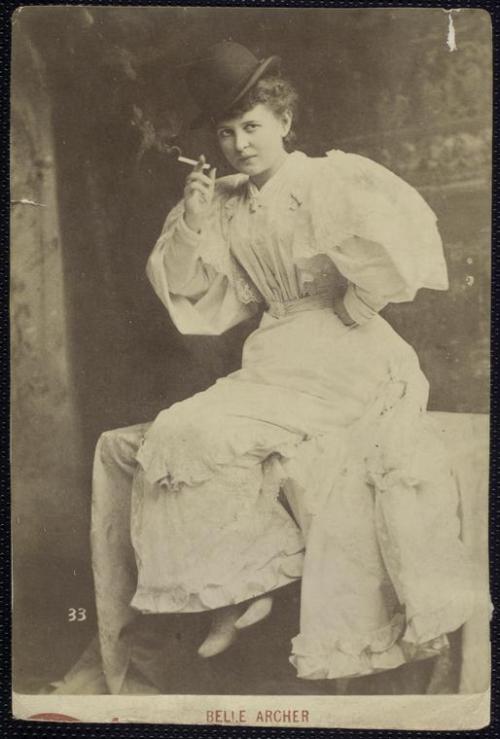
Belle Archer

Born in Easton, Pennsylvania - the daughter of the local postmaster, James Mingle - Belle Mingle Archer was a versatile actress and vocalist in the 1880s. The artist shone as Pitti-Sing in "The Mikado" at the Union Square Theatre in 1885. In that same year, Archer enjoyed a great hit as Tom Chickweed in "Alone in London," a melodrama, with Wallack's Theatre company. Here the actress poses in a snowy scene at the Falk studio in New York City. Archer was married to Herbert Archer, an actor who was best known for playing villains.

via Picture History, image via Sloth Unleashed


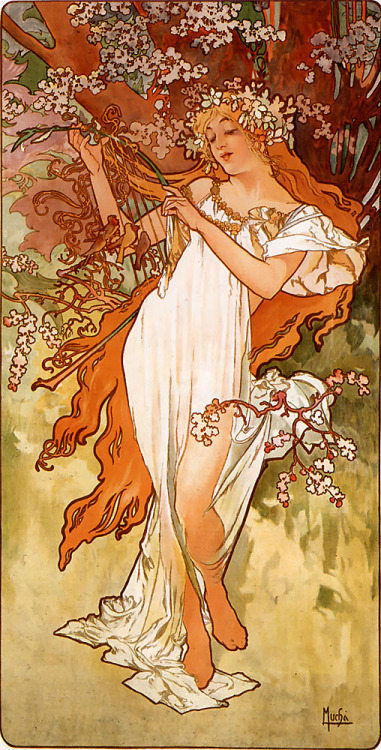
Alphons Mucha, Spring 1896

image via Turn of the Century


Maude Fealy
(March 4, 1883 – November 9, 1971) was an American stage and film actress. Fealy first gained public notice as a silent film actress, and successfully adapted to performing both on the stage, and, later, successfully adapted to acting in films with sound, a feat that many of her peers never successfully accomplished.

via Wikipedia, image via Sloth Unleashed


Polaire was the stage name used by French singer and actress Émilie Marie Bouchaud (May 14, 1874 – October 14, 1939).

Born at Agha, Algiers, Algeria, she began her show-business career as a café singer, at age 15. At 17, she joined her older brother in Paris, France. Eventually adopting the stage name Polaire, she worked as a music-hall singer; in 1895, her fame increased significantly when Henri de Toulouse-Lautrec's sketch of her appeared in the satirical magazine Le Rire.

A gifted comedic actress, she became one of the major celebrities of her day.

At a time when tightlacing among women was in vogue, she was famous for her tiny, corsetted waist, which was sometimes reported to have a circumference no greater than 14 inches Talk of her figure and her lavish overdressing in fur coats and dazzling jewels preceded her appearances wherever she went.

via Wikipedia, image via Turn of the Century


Fannie Ward (June 22, 1872 - January 27, 1952) was both a famous vaudeville and silent film actress.

Fannie Ward was born in St. Louis, Missouri and made her stage debut in 1890 in Peppina. She went on to become a very successful stage star for many years to come. Around 1890, she sailed for London and made a hit in music halls there, as well. She married diamond broker Joe Lewis who was worth an estimated $50 million. After a short break, she went back to the stage, returning to the United States in 1907. While playing in Madame President in 1913-1914, she divorced Lewis. In January 1916, she married her leading man, John Dean (1874-1950).

via Wikipedia, image via Turn of the Century

Saturday, March 13, 2010

Folks


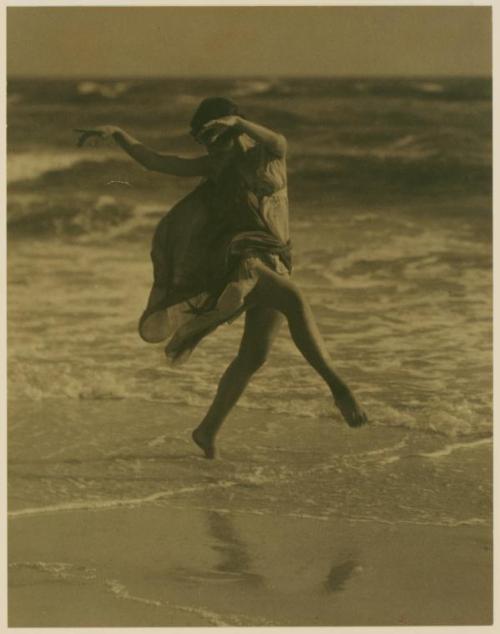
image via turnofthecentury.tumblr.com

Isadora Duncan (May 26, 1877 – September 14, 1927) was an American dancer. She is considered by many to be the creator of modern dance. In the United States she was popular only in New York, and then only later in her life. She performed to acclaim throughout Europe.

Duncan's fondness for flowing scarves was the cause of her death in a freak automobile accident in Nice, France. Duncan's large silk scarf while still draped around her neck, became entangled around one of the vehicle's open-spoked wheels and rear axle.

Angela Isadora Duncan was born in San Francisco, California, the youngest of the four children of Joseph Charles Duncan (1819–1898), a banker, mining engineer and connoisseur of the arts, and Mary Isadora Gray (1849–1922), youngest daughter of Thomas Gray, a California state senator, and his wife Mary Gorman. The other children were Elizabeth, Augustin, and Raymond.

Her father was the son of Joseph Moulder Duncan and Harriett Bioren. Soon after Isadora's birth, Joseph Duncan lost the bank and was publicly disgraced. Her parents were divorced by 1880 (the papers were lost in the San Francisco earthquake), and her mother Dora moved with her family to Oakland. She worked there as a pianist and music teacher. In her early years, Duncan did attend school but, finding it to be constricting to her individuality, she dropped out. As her family was very poor, both she and her sister gave dance classes to local children to earn extra money.

In 1895 Duncan became part of Augustin Daly's theater company in New York. She soon became disillusioned with the form. In 1899 she decided to move to Europe, first to London and then a year later, to Paris. Within two years she achieved both notoriety and success.

Her father, along with his third wife and their daughter, died in the 1898 sinking of the British passenger steamer SS Mohegan.

Montparnasse's developing Bohemian environment did not suit her. In 1909 Duncan moved to two large apartments at 5 rue Danton, where she lived on the ground floor and used the first floor for her dance school. Barefoot, dressed in clinging scarves and faux-Grecian tunics, she created a primitivist style of improvisational dance to counter the rigid styles of the time. She was inspired by the classics, especially Greek myth. She rejected traditional ballet steps to stress improvisation, emotion and the human form. Duncan believed that classical ballet, with its strict rules of posture and formation, was "ugly and against nature"; she gained a wide following that allowed her to set up a school to teach.

Duncan became so famous that she inspired artists and authors to create sculpture, jewelry, poetry, novels, photographs, watercolors, prints and paintings of her. When the Théâtre des Champs-Élysées was built in 1913, her likeness was carved in its bas-relief over the entrance by sculptor Antoine Bourdelle and included in painted murals of the nine muses by Maurice Denis in the auditorium.

In 1916 Duncan traveled to Brazil and performed at Rio de Janeiro's Teatro Municipal in August and at São Paulo's Teatro Municipal on September 2, 3 and 5 with pianist Maurice Dumesnil. Writer and journalist Paulo Barreto, known as João do Rio, claimed to have seen her dance "naked" in the forest of Tijuca, in front of Rio's most famous waterfall.

In 1922 she acted on her sympathy for the social and political revolution in the new Soviet Union and moved to Moscow. She cut a striking figure in the increasingly austere post-revolution capital, but her international prominence brought welcome attention to the new regime's artistic and cultural ferment. The Russian government's failure to follow through on extravagant promises of support for Duncan's work, combined with the country's spartan living conditions, sent her back to the West in 1924.

Throughout her career Duncan did not like the commercial aspects of public performance, regarding touring, contracts and other practicalities as distractions from her real mission: the creation of beauty and the education of the young. A gifted, if unconventional pedagogue, she was the founder of three schools dedicated to teaching her dance philosophy to groups of young girls (a brief effort to include boys was unsuccessful). The first, in Grunewald, Germany, gave rise to her most celebrated troupe of pupils, dubbed the Isadorables, who took her surname and subsequently performed both with Duncan and independently. The second school was short lived prior to World War I at a château outside Paris. She founded the third while in Moscow in the wake of the Russian Revolution.

Duncan's teaching and her pupils caused her both pride and anguish. Her sister, Elizabeth Duncan, took over the German school and adapted it to the Teutonic philosophy of her German husband. The Isadorables were subject to ongoing hectoring from Duncan over their willingness to perform commercially; Lisa Duncan was permanently ostracized for performing in nightclubs. The most notable of the group, Irma Duncan, remained in the Soviet Union after Isadora Duncan's departure. She ran the school there, angering her mentor Duncan by allowing students to perform in public and commercial venues.

Both in her professional and private lives, Duncan flouted traditional mores and morality. In 1922 she married the Russian poet Sergei Yesenin, who was 18 years her junior. Yesenin accompanied her on a tour of Europe; his alcoholism resulted in drunken rages, with repeated destruction of furniture and interiors of their hotel rooms, bringing Duncan much negative publicity. The following year he left Duncan and returned to Moscow, where he soon suffered a mental breakdown and was placed in a mental institution. Released from hospital, he allegedly committed suicide on December 28, 1925, at the age of 30.

Duncan bore two children, both out of wedlock—the first, Deirdre (born September 24, 1906), by theatre designer Gordon Craig, and the second, Patrick (born May 1, 1910)[1], by Paris Singer, one of the many sons of sewing machine magnate Isaac Singer.

Her private life was considered scandalous, especially following the drowning of Deirdre and Patrick in an accident on the Seine River on April 19, 1913. The children were in the car with their nurse, returning home after lunch with Isadora and Paris Singer. The driver stalled the car while attempting to avoid a collision. He got out to hand-crank the engine, but he had forgotten to set the parking brake, so once he got the car to start, it went across the Boulevard Bourdon and rolled down the embankment into the river below. The children and the nanny drowned.[1]

Following the accident, Duncan spent several months recuperating in Corfu with her brother and sister. After this, she spent several weeks at the Viareggio seaside resort with actress Eleonora Duse. The fact that Duse was just coming out of a lesbian relationship with rebellious young lesbian feminist Lina Poletti fueled speculation as to the nature of Duncan and Duse's relationship, but there has never been definite proof that the two were involved romantically.[2] In her autobiography, Duncan relates that she begged a young Italian stranger to sleep with her because of her desperation to have another baby. She did, indeed become pregnant right after the deaths of her children. She gave birth to a son, who lived only a few hours and was never named.

During her last United States tour, in 1922-23, Duncan waved a red scarf and bared her breast on stage in Boston, proclaiming, "This is red! So am I!". She was bisexual, which was not uncommon in early Hollywood circles. She had a lengthy and passionate affair with poet Mercedes de Acosta.[3]

Duncan and de Acosta wrote regularly in often revealing letters of correspondence. In one from 1927, Duncan wrote: (quoted by Hugo Vickers in "Loving Garbo") "...A slender body, hands soft and white, for the service of my delight, two sprouting breasts round and sweet, invite my hungry mouth to eat, from whence two nipples firm and pink, persuade my thirsty soul to drink, and lower still a secret place where I'd fain hide my loving face...."[4] In another letter to de Acosta she wrote: "Mercedes, lead me with your little strong hands and I will follow you—to the top of a mountain. To the end of the world. Wherever you wish." Isadora, June 28, 1926.[4] De Acosta had once proclaimed that from the moment she first saw Isadora Duncan, she looked upon her as a great genius, and was taken by her completely.[4]

By the end of her life Duncan's performing career had dwindled and she became as notorious for her financial woes, scandalous love life and all-too-frequent public drunkenness as for her contributions to the arts. She spent her final years moving between Paris and the Mediterranean, running up debts at hotels. She spent short periods in apartments rented on her behalf by an ever-decreasing number of friends and supporters, many of whom attempted to assist her in writing an autobiography. They hoped it might be sufficiently successful to support her. In a reminiscent sketch, Zelda Fitzgerald recalled how she and F. Scott sat in a Paris cafe watching a somewhat drunk Duncan. He would speak of how memorable it was, but what Zelda recalled was that while all eyes were watching Duncan, Zelda was able to steal the salt and pepper shakers from the table.

In her book Isadora, an Intimate Portrait, Sewell Stokes, who met Duncan in the last years of her life, describes her extravagant waywardness. Duncan's autobiography My Life was published in 1927. Composer Percy Grainger called Isadora's autobiography a "life-enriching masterpiece." [5]

Duncan's fondness for flowing scarves was the cause of her death in a freak automobile accident in Nice, France, on the night of September 14, 1927, at the age of 50. The scarf was hand-painted silk from the Russian-born artist Roman Chatov. The accident gave rise to Gertrude Stein's mordant remark that "affectations can be dangerous."

Duncan was a passenger in the Amilcar[6] automobile of a handsome French-Italian mechanic Benoît Falchetto, whom she had nicknamed "Buggatti" (sic). Before getting into the car, she reportedly said to her friend Mary Desti and some companions, "Adieu, mes amis. Je vais à la gloire!" (Goodbye, my friends, I am off to glory!). However, according to American novelist Glenway Wescott, who was in Nice at the time and visited Duncan's body in the morgue, Desti admitted that she had lied about Duncan's last words. Instead, she told Wescott, Duncan said, "Je vais à l'amour" (I am off to love). Desti considered this too embarrassing to be recorded as the dance legend's last words, especially as it suggested that Duncan hoped that she and Falchetto were going to her hotel for a sexual assignation.

When Falchetto drove off Duncan's large silk scarf, a gift from Desti, and draped around her neck, became entangled around one of the vehicle's open-spoked wheels and rear axle. As The New York Times noted in its obituary: "Isadora Duncan, the American dancer, tonight met a tragic death at Nice on the Riviera. According to dispatches from Nice, Miss Duncan was hurled in an extraordinary manner from an open automobile in which she was riding and instantly killed by the force of her fall to the stone pavement."[7] Other sources described her death as resulting from strangulation, noting that she was almost decapitated by the sudden tightening of the scarf around her neck.[8]

Isadora Duncan was cremated, and her ashes were placed next to those of her beloved children[9] in the columbarium at Père Lachaise Cemetery in Paris. Ironically, the headstone of her grave contains the inscription in French: "The Paris Opera Ballet School."

At her death, she was a Soviet citizen. Her will was the first of a Soviet citizen to be probated in the U.S.

via Wikipedia

Isadora Duncan, by Vic Chesnutt

Wednesday, March 3, 2010

That's Gotta Hurt!


To celebrate our new album, I thought I'd pay homage to our rag tag music collective of misfits by putting Hands Down Eugene and Good Americans' Matt Moody on here. Matt is so devoted to Trey Deuce that he got it stitched on his forearm. Go team! But really, Matt is a stellar musician and all-around good guy. To hear more of his music, go to the Hands Down Eugene site, and for a sampling of the Good Americans, you can find them here. Take a listen.

Sunday, December 20, 2009

Folks


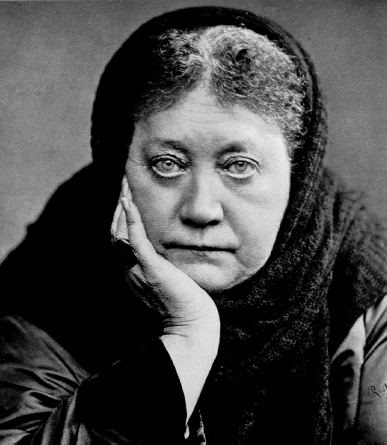
Elena Petrovna Gan (Russian: Елена Петровна Ган, also Hélène, Ukrainian: Олена Петрівна Ган; 12 August [O.S. 31 July] 1831, Yekaterinoslav, Yekaterinoslav, Russian Empire (today Dnipropetrovsk, Ukraine) – May 8, 1891, London), better known as Helena Blavatsky (Russian: Елена Блаватская, Ukrainian: Олена Петрівна Блаватська) or Madame Blavatsky, born Helena von Hahn, was a founder of Theosophy and the Theosophical Society.

Her parents were Colonel Pyotr Alekseyevich Gan (Пётр Алексеевич Ган) or Peter von Hahn (1798–1873) of ancient (uradel) German nobility from Basedow (Mecklenburg)—and Elena Andreyevna Fadeyeva (Елена Андреевна Фадеева, 1814–1843), the author, under the pen-name "Zeneida R-va", of a dozen novels. Described by Belinsky as the "Russian George Sand", she died at the age of 28, when Helena was eleven. Helena's sister Vera Zhelikhovsky was a writer of occult/ fantastic fiction. Helena's first cousin was Sergei Witte, who was Russian Minister, and then Prime Minister in the reign of Tsar Nicholas II. In his memoirs, Count Witte recalls his encounters with Helena.

Helena's maternal grandparents were Andrey Mikhailovich Fadeyev, Governor of Saratov, later of Tbilisi, and his wife Princess Helene Dolgoruki prominent figures of the age of Russian enlightenment. Helena grew up amid a culture rich in spirituality and traditional Russian mythologies, which introduced her to the realm of the supernatural.

Helena's great-grand nephew Boris de Zirkoff (Борис Цирков, 1902–1981) was an active member of the Theosophical Society and editor of the Blavatsky Collected Writings; her great-grand niece, also Helena (b. 1935), lives in Moscow—her resemblance to HPB is striking.

She was married four weeks before she turned seventeen, on July 7, 1848, to the forty-year old Nikifor (also Nicephor) Vassilievich Blavatsky, vice-governor of Erivan. After three unhappy months, she stole a horse and escaped back over the mountains to her grandfather in Tbilisi. Her grandfather shipped her off immediately to her father, who was retired and living near Saint Petersburg. He travelled two thousand miles[clarification needed] to meet her at Odessa, but she wasn't there. She had missed the steamer, and sailed away with the skipper of an English bark bound for Istanbul. According to her account, they never consummated their marriage,[2] and she remained a virgin her entire life.

According to her own story as told to a later biographer, she spent the years 1848 to 1858 traveling the world, and is said to have visited Egypt, France, Canada (Quebec), England, South America, Germany, Mexico, India, Greece and especially Tibet to study for two years with the men she called Brothers. She claimed to have become Buddhist while in Sri Lanka[3] and to have been initiated in Tibet. She returned to Russia in 1858 and went first to see her sister Vera, a young widow living in Rugodevo, a village which she had inherited from her husband.

It was in 1873 that she emigrated to New York City. Impressing people with her professed psychic abilities, she was spurred on to continue her mediumship. Mediumship (among other psychical and spiritual sciences of the time), based upon the belief known as Spiritualism which began at Rochester, NY, was a widely popular and fast-spreading field upon which Blavatsky based her career.[5]

Throughout her career she claimed to have demonstrated physical and mental psychic feats which included levitation, clairvoyance, out-of-body projection, telepathy, and clairaudience. Another claim of hers was materialization, that is, producing physical objects out of nothing, though in general, her interests were more in the area of 'theory' and 'laws' rather than demonstration.

In 1874 at the farm of the Eddy Brothers, Helena met Henry Steel Olcott, a lawyer, agricultural expert, and journalist who covered the Spiritualist phenomena. Soon they were working together in the "Lamasery" (alternate spelling: "Lamastery") where her book Isis Unveiled was written.

Blavatsky married her second husband, Michael C. Betanelly on April 3, 1875 in New York City. She separated from Betanelly after a few months, and their divorce was legalized on May 25, 1878. On July 8, 1878, she became a naturalized citizen of the United States, but after leaving for India later that year she never returned to the country.

Living in New York City, she helped found the Theosophical Society in September 1875, with Henry Steel Olcott, William Quan Judge and others.

Blavatsky wrote that all religions were both true in their inner teachings and problematic or imperfect in their external conventional manifestations.[citation needed] Her writings connecting esoteric spiritual knowledge with new science may be considered to be the first instance of what is now called New Age thinking, "the hippy movement of the last quarter of the twentieth century".[6]

She also lived in Philadelphia for part of 1875, where she resided at 3420 Sansom Street, now home of the White Dog Cafe.[7] While living on Sansom Street, Madame Blavatsky became ill with an infected leg. She claimed to have undergone a "transformation" during her illness which inspired her to found the Theosophical Society. In a letter dated June 12, 1875, she described her recovery, explaining that she dismissed the doctors and surgeons who threatened amputation. She is quoted as saying "Fancy my leg going to the spirit land before me!", and had a white dog sleep across her leg by night.

In August, 1890 she formed the "Inner Circle" of 12 disciples: "Countess Constance Wachtmeister, Mrs Isabel Cooper-Oakley, Miss Emily Kislingbury, Miss Laura Cooper, Mrs Annie Besant, Mrs Alice Cleather, Dr Archibald Keightley, Herbert Coryn, Claude Wright, G. R. S. Mead, E. T. Sturdy, and Walter Old".[12]

Suffering from Bright's disease and complications from influenza, Blavatsky died in her home at 19 Avenue Road, St Johns Wood, London, on May 8, 1891.[4] Her last words in regard to her work were: "Keep the link unbroken! Do not let my last incarnation be a failure." Her body was cremated at Woking on May 11;[4] one third of her ashes were sent to Europe, one third with William Quan Judge to the United States, and one third to India where her ashes were scattered in the Ganges River. May 8 is celebrated by Theosophists, and it is called White Lotus Day.

Following Blavatsky's death, the Theosophical Society split in two, each part claiming her as its "rightful progenitor".[13] One branch was headed by her protégé, Annie Besant, and the other, the American Section, by her friend W. Q. Judge.

Well-known and controversial during her life, Blavatsky was influential on spiritualism and related subcultures: "the western esoteric tradition has no more important figure in modern times."[14] She wrote prolifically, publishing thousands of pages, and debate continues about her claims.

Throughout much of Blavatsky's public life, her work drew harsh criticism from some of the learned authorities of her day, who accused her of being a charlatan, an impostor, and a fraud.

In The New York Times Edward Hower wrote, "Theosophical writers have defended her sources vehemently. Skeptics have painted her as a great fraud."[15]

The authenticity and originality of her writings were questioned. Blavatsky was accused of having plagiarized a number of sources, copying the texts crudely enough to misspell the more difficult words. See: The Sources of Madame Blavatsky's Writings by William Emmette Coleman from Modern Priestess of Isis by Vsevolod Sergyeevich Solovyoff (Author), Walter Leaf (Translator)[16]

In his 1885 report to the Society for Psychical Research (SPR), Richard Hodgson concluded that Blavatsky was a fraud. However, in a 1986 press release to the newspapers and leading magazines in Great Britain, Canada and the USA the same SPR retracted the Hodgson report, after a re-examination of the case by the Fortean psychic Dr. Vernon Harrison, past president of The Royal Photographic Society and formerly Research Manager to Thomas De La Rue, an expert on forgery, as follows: "Madame Blavatsky, co-founder of the Theosophical Society, was unjustly condemned, new study concludes."[17]

Blavatsky famously favored an Aryan race and for her advocation of a superior race, based on Indian culture. Blavatsky argued that all humanity descended from seven root races, with the fifth one being the Aryan race.[18]

Since her death, Blavatsky's work has shown its influence in the works of dictators, political leaders, new religion leaders, writers, musicians, and other public figures.

via Wikipedia

Friday, October 16, 2009

Folks


Pablo Neruda (July 12, 1904 – September 23, 1973) was the pen name and, later, legal name of the Chilean writer and politician Neftalí Ricardo Reyes Basoalto. Neruda assumed his pen name as a teenager, partly because it was in vogue, partly to hide his poetry from his father, a rigid man who wanted his son to have a "practical" occupation. Neruda's pen name was derived from Czech writer and poet Jan Neruda; Pablo is thought to be from Paul Verlaine. With his works translated into many languages, Pablo Neruda is considered one of the greatest and most influential poets of the 20th century.

Neruda was accomplished in a variety of styles ranging from erotically charged love poems like his collection Twenty Poems of Love and a Song of Despair, surrealist poems, historical epics, and overtly political manifestos. In 1971 Neruda won the Nobel Prize for Literature, a controversial award because of his political activism. Colombian novelist Gabriel García Márquez once called him "the greatest poet of the 20th century in any language."[1]

On July 15, 1945, at Pacaembu Stadium in São Paulo, Brazil, he read to 100,000 people in honor of Communist revolutionary leader Luís Carlos Prestes.[2] When Neruda returned to Chile after his Nobel Prize acceptance speech, Salvador Allende invited him to read at the Estadio Nacional before 70,000 people.[3]

During his lifetime, Neruda occupied many diplomatic posts and served a stint as a senator for the Chilean Communist Party. When Conservative Chilean President González Videla outlawed communism in Chile, a warrant was issued for Neruda's arrest. Friends hid him for months in a house basement in the Chilean port of Valparaíso. Later, Neruda escaped into exile through a mountain pass near Maihue Lake into Argentina. Years later, Neruda was a close collaborator to socialist President Salvador Allende.

Neruda was hospitalized with cancer at the time of the Chilean coup d'état led by Augusto Pinochet. Three days after being hospitalized, Neruda died of heart failure. Already a legend in life, Neruda's death reverberated around the world. Pinochet had denied permission to transform Neruda's funeral into a public event. However, thousands of grieving Chileans disobeyed the curfew and crowded the streets. Neruda's funeral became the first public protest against the Chilean military dictatorship.

Ricardo Eliezer Neftalí Reyes y Basoalto was born in Parral, a city in Linares Province in the Maule Region, some 350 km south of Santiago. His father, José del Carmen Reyes Morales, was a railway employee; his mother, Rosa Basoalto, was a school teacher who died two months after he was born. Neruda and his father soon moved to Temuco, where his father married Trinidad Candia Marverde, a woman with whom he had had a child nine years earlier, a boy named Rodolfo. Neruda also grew up with his half-sister Laura, one of his father's children by another woman.

The young Neruda was christened "Neftalí", his late mother's middle name. His father was opposed to Neruda's interest in writing and literature, but Neruda received encouragement from others, including future Nobel Prize winner Gabriela Mistral, who headed the local girls' school. His first published work was an essay he wrote for the local daily newspaper, La Mañana, at the age of thirteen: Entusiasmo y perseverancia ("Enthusiasm and Perseverance"). By 1920, when he adopted the pseudonym of Pablo Neruda, he was a published author of poetry, prose, and journalism.

In the following year (1921), he moved to Santiago to study French at the Universidad de Chile with the intention of becoming a teacher, but soon Neruda was devoting himself full time to poetry. In 1923 his first volume of verse, Crepusculario ("Book of Twilights"), was published, followed the next year by Veinte poemas de amor y una canción desesperada ("Twenty Love Poems and a Desperate Song"), a collection of love poems that was controversial for its eroticism, especially considering its author's young age. Both works were critically acclaimed and were translated into many languages. Over the decades, Veinte poemas would sell millions of copies and become Neruda's best-known work.

Neruda's reputation was growing both inside and outside of Chile, but he was plagued by poverty. In 1927, out of desperation, he took an honorary consulship in Rangoon, then a part of colonial Burma and a place of which he had never heard before. Later, he worked stints in Colombo (Ceylon), Batavia (Java), and Singapore. In Java he met and married his first wife, a tall Dutch bank employee named Maryka Antonieta Hagenaar Vogelzang. While on diplomatic service, Neruda read large amounts of poetry and experimented with many different poetic forms. He wrote the first two volumes of Residencia En La Tierra, which included many surrealistic poems.

After returning to Chile, Neruda was given diplomatic posts in Buenos Aires and then Barcelona, Spain. He later replaced Gabriela Mistral as consul in Madrid, where he became the center of a lively literary circle, befriending such writers as Rafael Alberti, Federico García Lorca, and the Peruvian poet César Vallejo. A daughter, Malva Marina Trinidad, was born in Madrid in 1934; she was to be plagued with health problems, especially hydrocephalus, for the whole of her short life. During this period, Neruda became slowly estranged from his wife and took up with Delia del Carril, an Argentine woman who was twenty years his senior and who would eventually become his second wife. He divorced from his Dutch wife in 1936, who moved to the Netherlands with his only child; this child died in 1943.

As Spain became engulfed in civil war, Neruda became intensely politicized for the first time. His experiences of the Spanish Civil War and its aftermath moved him away from distinctive, privately focused labor in the direction of collective obligation and better cohesion. Neruda became an ardent communist, and remained so for the rest of his life. The radical leftist politics of his literary friends, as well as that of del Carril, were contributing factors, but the most important catalyst was the execution of García Lorca by forces loyal to Francisco Franco. By means of his speeches and writings, Neruda threw his support behind the Republican side, publishing a collection of poetry called España en el corazón ("Spain in My Heart"). Neruda’s wife and child moved to Monte Carlo; he was never to see either of them again. After leaving his wife, he took up full time with del Carril in France.

Following the election in 1938 of President Pedro Aguirre Cerda, whom Neruda supported, he was appointed special consul for Spanish emigration in Paris. There Neruda was given responsibility for what he called "the noblest mission I have ever undertaken": shipping 2,000 Spanish refugees, who had been housed by the French in squalid camps, to Chile on an old boat called the Winnipeg. Neruda is sometimes charged with only selecting Communists for emigration while excluding others who had fought on the side of the Republic[citation needed]; others deny these accusations, pointing out that Neruda chose only a few hundred of the refugees personally; the rest were selected by the Service for the Evacuation of Spanish Refugees, set up by Juan Negrín, president of the Spanish Republican government-in-exile.

Neruda's next diplomatic post was as Consul General in Mexico City, where he spent the years 1940 to 1943. While in Mexico, he divorced Hagenaar, married del Carril, and learned that his daughter had died, age eight, in Nazi-occupied Netherlands from various health problems. He also became a friend of the Stalinist assassin Vittorio Vidali.

After the failed 1940 assassination attempt against Leon Trotsky, Neruda arranged a Chilean visa for the Mexican painter David Alfaro Siqueiros who was accused of having been one of the conspirators. Neruda later said he did it at the request of Mexican President Manuel Ávila Camacho. This enabled Siqueiros, then jailed, to leave Mexico for Chile, where he stayed at Neruda's private residence. In exchange for Neruda's assistance, Siqueiros spent over a year painting a mural in a school in Chillán. Neruda's relationship with Siqueiros attracted criticism and Neruda dismissed the allegations that his intent had been to help an assassin as "sensationalist politico-literary harassment". In Mexico, Pablo Neruda met the famous Mexican writer Octavio Paz where he nearly came to blows in 1942.

In 1943, following his return to Chile, Neruda made a tour of Peru, where he visited Machu Picchu. The austere beauty of the Inca citadel later inspired Alturas de Macchu Picchu, a book-length poem in twelve parts which he completed in 1945 and which marked a growing awareness and interest in the ancient civilizations of the Americas: themes he was to explore further in Canto General. In this work, Neruda celebrated the achievement of Machu Picchu, but also condemned the slavery which had made it possible. In the Canto XII, he called upon the dead of many centuries to be born again and to speak through him. Martin Espada, poet and professor of creative writing at the University of Massachusetts, has hailed the work as a masterpiece, declaring that "there is no greater political poem".

Bolstered by his experiences in the Spanish Civil War, Neruda, like many left-leaning intellectuals of his generation, came to admire the Soviet Union of Joseph Stalin, partly for the role it played in defeating Nazi Germany (poems Canto a Stalingrado (1942) and Nuevo canto de amor a Stalingrado (1943)). In 1953 Neruda was awarded the Stalin Peace Prize. On Stalin's death that same year, Neruda wrote an ode to him, as he also (during World War II) wrote praise of Fulgencio Batista (Saludo a Batista, i.e Salute to Batista) and later to Fidel Castro.

His fervent Stalinism eventually drove a wedge between Neruda and longtime friend Octavio Paz who commented that "Neruda became more and more Stalinist, while I became less and less enchanted with Stalin".[citation needed] Their differences came to a head after the 1939 Nazi-Soviet Ribbentrop-Molotov Pact when they almost came to blows in an argument over Stalin. Although Paz still considered Neruda "the greatest poet of his generation", in an essay on Aleksandr Solzhenitsyn he wrote that when he

thinks of … Neruda and other famous Stalinist writers I feel the gooseflesh that I get from reading certain passages of Dante’s Inferno. No doubt they began in good faith, but insensibly, commitment by commitment, they saw themselves becoming entangled in a mesh of lies, falsehoods, deceits and perjuries, until they lost their souls.[citation needed]

Neruda called Lenin the "great genius of this century". Another speech (June 5, 1946) is a tribute to the late Soviet leader Mikhail Kalinin, who for Neruda was "man of noble life", "the great constructor of the future", "a comrade of arms of Lenin and Stalin". [1]

Neruda later came to rue his support of the Soviet leader; after Nikita Khrushchev's famous Secret Speech at the Soviet 20th Party Congress in 1956, which denounced the "cult of personality" that surrounded Stalin and accused him of committing crimes during the Great Purges, Neruda wrote in his memoirs "I had contributed to my share to the personality cult," explaining that "in those days, Stalin seemed to us the conqueror who had crushed Hitler's armies". Of a subsequent visit to China in 1957, Neruda would later write: "What has estranged me from the Chinese revolutionary process has not been Mao Tse-tung but Mao Tse-tungism", which he dubbed Mao Tse-Stalinism: "the repetition of a cult of a Socialist deity".[citation needed] However, despite his disillusionment with Stalin, Neruda never lost his essential faith in communist theory and remained loyal to "the Party". Anxious not to give ammunition to his ideological enemies, he would later refuse publicly to condemn the Soviet repression of dissident writers like Boris Pasternak and Joseph Brodsky: an attitude with which even some of his staunchest admirers disagreed.

On March 4, 1945 Neruda was elected a Communist party senator for the northern provinces of Antofagasta and Tarapacá in the arid and inhospitable Atacama Desert. He officially joined the Communist Party of Chile four months later.

In 1946, Radical Party presidential candidate Gabriel González Videla asked Neruda to act as his campaign manager. González Videla was supported by a coalition of left-wing parties and Neruda fervently campaigned on his behalf. Once in office, however, González Videla turned against the Communist Party. The breaking point for Senator Neruda was the violent repression of a Communist-led miners' strike in Lota in October 1947, where striking workers were herded into island military prisons and a concentration camp in the town of Pisagua. Neruda's criticism of González Videla culminated in a dramatic speech in the Chilean senate on 6 January 1948 called Yo acuso ("I accuse"), in the course of which he read out the names of the miners and their families who were imprisoned at the concentration camp.

A few weeks later, Neruda went into hiding and he and his wife were smuggled from house to house, hidden by supporters and admirers for the next thirteen months. While in hiding, Senator Neruda was removed from office and in September 1948 the Communist Party was banned altogether under the Ley de Defensa Permanente de la Democracia (Law for the Permanent Defense of Democracy), called by critics the Ley Maldita ("Accursed Law"), which eliminated over 26,000 people from the electoral registers, thus stripping them of their right to vote. Neruda moved later to Valdivia in southern Chile. Neruda's life underground ended in March 1949 when he fled over the Lilpela Pass on the Andes Mountains to Argentina on horseback. He would dramatically recount his escape from Chile in his Nobel Prize lecture.

Once out of Chile, he spent the next three years in exile. In Buenos Aires a friend of Neruda, the future Nobel winner and novelist Miguel Ángel Asturias, was cultural attaché to the Guatemalan embassy. There was some slight resemblance between the two men, so Neruda went to Europe using Asturias's passport. Pablo Picasso arranged his entrance into Paris[citation needed] and Neruda made a surprise appearance there to a stunned World Congress of Peace Forces, the Chilean government meanwhile denying[citation needed] that the poet could have escaped the country.

Neruda spent those three years traveling extensively throughout Europe as well as taking trips to India, China, Sri Lanka and the Soviet Union. His trip to Mexico in late 1949 was lengthened due to a serious bout of phlebitis. A Chilean singer named Matilde Urrutia was hired to care for him and they began an affair that would, years later, culminate in marriage. During his exile, Urrutia would travel from country to country shadowing him and they would arrange meetings whenever they could. Matilde Urrutia was the muse for "Los versos del Capitán", which he later published anonymously in 1952.

While in Mexico, Neruda also published his lengthy epic poem Canto General, a Whitmanesque catalog of the history, geography, and flora and fauna of South America, accompanied by Neruda's observations and experiences. Many of them dealt with his time underground in Chile, which is when he composed much of the poem. In fact, he had carried the manuscript with him on his escape on horseback. A month later, a different edition of five thousand copies was boldly published in Chile by the outlawed Communist Party based on a manuscript Neruda had left behind. In Mexico, he was granted honorary Mexican citizenship.

His 1952 stay in a villa owned by Italian historian Edwin Cerio on the island of Capri was fictionalized in the popular film Il Postino ("The Postman", 1994).

By 1952, the González-Videla government was on its last legs, weakened by corruption scandals. The Chilean Socialist Party was in the process of nominating Salvador Allende as its candidate for the September 1952 presidential elections and was keen to have the presence of Neruda—by now Chile's most prominent left-wing literary figure—to support the campaign.

Neruda returned in August of that year and rejoined Delia del Carril, who had traveled ahead of him some months earlier, but the marriage was crumbling. Del Carril eventually learned of his torrid affair with Matilde Urrutia and left him in 1955, moving back to Europe. Now united with Urrutia, Neruda would spend the rest of his life in Chile, many foreign trips notwithstanding and a stint as Allende's ambassador to France from 1970 to 1973.

By this time, Neruda enjoyed worldwide fame as a poet, and his books were being translated into virtually all the major languages of the world. He was also vocal on political issues, vigorously denouncing the U.S. during the Cuban missile crisis (later in the decade he would likewise repeatedly condemn the U.S. for the Vietnam War). But being one of the most prestigious and outspoken leftwing intellectuals alive also attracted opposition from ideological opponents. The Congress for Cultural Freedom, an anti-communist organization covertly established and funded by the U.S. Central Intelligence Agency, adopted Neruda as one of its primary targets and launched a campaign to undermine his reputation, reviving the old claim he had been an accomplice in the attack on Trotsky in Mexico City in 1940[citation needed]. The campaign became more intense when it became known that Neruda was a candidate for the 1964 Nobel prize, which was eventually awarded to Jean-Paul Sartre.

In 1966, Neruda was invited to attend an International PEN conference in New York City. Officially, he was barred from entering the U.S. because he was a communist, but the conference organizer, playwright Arthur Miller, eventually prevailed upon the Johnson Administration to grant Neruda a visa. Neruda gave readings to packed halls, and even recorded some poems for the Library of Congress. Miller later opined that Neruda's adherence to his communist ideals of the 1930s was a result of his protracted exclusion from "bourgeois society". Due to the presence of many East Bloc writers, Mexican writer Carlos Fuentes later wrote that the PEN conference marked a "beginning of the end" of the Cold War.

Upon Neruda's return to Chile, he stopped off in Peru, where he gave readings to enthusiastic crowds in Lima and Arequipa and was received by President Fernando Belaúnde Terry. However, the visit prompted an unpleasant backlash. The Peruvian government had come out against the government in Cuba of Fidel Castro, and in July 1966 retaliation against Neruda came in the form of a letter signed by more than one hundred Cuban intellectuals who charged Neruda with colluding with the enemy, and called him an example of the "tepid, pro-Yankee revisionism" then prevalent in Latin America. The affair was particularly painful for Neruda because of his previous outspoken support for the Cuban revolution, and he never visited the island again, even after an invitation in 1968.

After the death of Che Guevara in Bolivia in 1967, Neruda wrote several articles regretting the loss of a "great hero".[citation needed] At the same time, he told his friend Aida Figueroa not to cry for Che, but for Luis Emilio Recabarren, the father of the Chilean communist movement, who preached a pacifist revolution over Che's violent ways.[4]

In 1970, Neruda was nominated as a candidate for the Chilean presidency, but ended up giving his support to Salvador Allende, who later won the election and was inaugurated in 1970 as the first democratically elected socialist head of state. Shortly thereafter, Allende appointed Neruda the Chilean ambassador to France (lasting from 1970-1972; his final diplomatic posting). Neruda returned to Chile two and half years later due to failing health.

In 1971, having sought the prize for years, Neruda was finally awarded the Nobel Prize. This decision did not come easily, as some of the committee members had not forgotten Neruda's past praise of Stalinist dictatorship. But his Swedish translator, Artur Lundkvist, did his best to ensure the Chilean the prize.[5]

As the disturbances of 1973 unfolded, Neruda, then terminally ill with prostate cancer, was devastated by the mounting attacks on the Allende government. The military coup led by General Augusto Pinochet on 11 September saw Neruda's hopes for a marxist Chile destroyed. Shortly thereafter, during a search of the house and grounds at Isla Negra by Chilean armed forces at which he was present, Neruda famously remarked:

Look around—there's only one thing of danger for you here—poetry.

Neruda died of heart failure on the evening of September 23, 1973, at Santiago's Santa María Clinic.[6][7][8] The funeral took place amidst a massive police presence, and mourners took advantage of the occasion to protest against the new regime, established just a couple of weeks before.

Matilde Urrutia subsequently compiled and edited for publication the memoirs that Neruda had been working on just days prior to his death including, possibly his final poem 'Right Comrade, It's the Hour of the Garden'. These and other activities brought her into conflict with Pinochet's government, which continually sought to curtail Neruda's influence on the Chilean collective consciousness. Urrutia's own memoir, My Life with Pablo Neruda, was published posthumously in 1986.

Neruda owned three houses in Chile; today they are all open to the public as museums: La Chascona in Santiago, La Sebastiana in Valparaíso, and Casa de Isla Negra in Isla Negra, where he and Matilde Urrutia are buried.

via Wikipedia